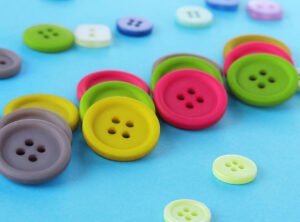
A button may measure only a few millimetres across, but its dimensions determine much more than its appearance. Diameter affects the proportion of the button on a finished product, while thickness influences its profile, handling, sewing and interaction with the buttonhole. For Button Manufacturers in India, controlling these dimensions accurately is therefore an important part of producing a consistent and functional polyester button. Button sizes are traditionally expressed in ligne, abbreviated as L. One ligne equals 0.635 mm, or 1/40 of an inch. A 20L button, for example, has a nominal diameter of approximately 12.7 mm, while a 24L button is about 15.24 mm and a 32L button about 20.32 mm. These differences may appear small numerically, but they can noticeably change the way a button fits into a product.
The importance of precision is also recognised in established test methods for plastic sew-through buttons. ASTM D5171-15(2025), which addresses impact resistance, identifies ligne size and thickness along with button shape, number of holes and hole spacing as factors influencing resistance to failure under impact. This makes dimensional accuracy a practical manufacturing consideration rather than simply a matter of visual uniformity. For Button Manufacturers in India, the challenge is to convert a defined size and thickness into a repeatable finished product. That requires control at different stages of polyester button production, from sheet preparation to cutting, shaping and subsequent finishing.
Precision in button manufacturing is essentially about consistency. If one batch is specified as a particular ligne size and thickness, the finished buttons need to remain close to that specification throughout the production quantity. The objective is not only to produce a button that looks correct but to ensure that its dimensions remain stable enough for the same application, sewing method and buttonhole specification. For a company such as Classic Buttons Pvt. Ltd., which has been manufacturing polyester buttons for more than four decades and has an installed capacity of over 7 million buttons per day, maintaining repeatability becomes particularly important at scale.
1. BUTTON SIZE IS DEFINED PRECISELY, NOT APPROXIMATELY
The term “button size” can sound simple, but in professional button manufacturing it represents a specific measurement. Ligne is the established unit for button diameter, with 1L equal to 0.635 mm. For example, the difference between a 20L button and a 24L button is approximately 2.54 mm in diameter. For Button Manufacturers in India, this makes accurate size interpretation important because two buttons described simply as “medium-sized” could have meaningfully different actual dimensions.
A manufacturer working from a purchase specification has to translate the required ligne size into the physical dimensions of the finished button. This becomes especially important when buyers are working from an approved sample or an established product specification. A small difference that might not appear significant in isolation can become obvious when repeated across a large quantity.
2. THICKNESS DESERVES THE SAME ATTENTION AS DIAMETER
Diameter is normally the first dimension considered because it is visible from the face of the button, but thickness is equally important to the finished component. ASTM D5171 specifically identifies thickness as one of the factors influencing the impact resistance of plastic sew-through buttons.
For Button Manufacturers in India, thickness affects the overall profile of a button and its relationship with the material to which it is attached. Two buttons can have the same diameter but behave differently when their thicknesses are different. One may have a relatively low profile, while another may project further from the surface. Thickness therefore needs to be treated as a defined production dimension rather than an incidental characteristic of the product.
3. LIGNE MEASURES DIAMETER, NOT THICKNESS
One common source of confusion is assuming that a button’s ligne designation describes its complete size. It does not. Ligne refers to the diameter of the button face. Thickness is a separate dimension and has to be specified independently.
This distinction matters when Button Manufacturers in India are developing or supplying products against detailed requirements. A specification stating only “24L” establishes the nominal diameter, but it does not completely define the physical dimensions of the button. The manufacturer and buyer may also need to establish thickness, hole arrangement, shape and other relevant dimensions depending on the application.
4. SMALL DIFFERENCES BECOME MORE NOTICEABLE ON REPEATED COMPONENTS
Dimensional variation is easier to overlook in one individual button than across a large quantity. When hundreds or thousands of buttons are produced to the same specification, differences in diameter or thickness can become visually obvious when the pieces are placed together.
For Button Manufacturers in India, repeatability is therefore more important than simply achieving the correct dimension on an individual piece. Consistency across a production quantity helps ensure that buttons supplied for the same product specification maintain a uniform appearance and physical profile. This is particularly relevant for buyers placing repeat orders, where the expectation is that later quantities will remain consistent with the approved product.
5. THE BUTTON MUST MATCH THE BUTTONHOLE
A button does not function independently. Its diameter and thickness have to work with the buttonhole through which it is intended to pass. Industry sizing references commonly associate smaller ligne sizes with shirting and other fine applications, while larger sizes are used for jackets and outerwear.
This is why Button Manufacturers in India need to consider the intended application when working with dimensions. A button that is technically correct according to its nominal diameter may still be unsuitable if its dimensions do not correspond with the buttonhole and construction of the finished product. The relationship between the button and the opening is therefore part of functional compatibility.
6. THICKNESS CHANGES THE BUTTON’S PROFILE
Diameter determines how much surface area the button occupies, while thickness determines how far it projects from the surface on which it is sewn. This difference is particularly noticeable in products where a flatter button profile is preferred.
For Button Manufacturers in India, controlling thickness is important because a change in profile can alter the visual character of the finished button. It can also affect the way the button sits against the material after sewing. A button with a consistent diameter but varying thickness will not present the same profile across the production quantity, which is why both dimensions need to be controlled together.
7. HOLE PLACEMENT IS PART OF DIMENSIONAL ACCURACY
The external diameter is only one part of a button’s geometry. Hole number and hole spacing also influence how the button performs. ASTM D5171 identifies both the number and spacing of holes, together with ligne size and thickness, among the factors that can influence impact resistance.
For Button Manufacturers in India, this means dimensional control has to extend beyond the circumference of the button. The relationship between the outer edge, centre point and holes has to remain consistent with the intended design. Even where the outer diameter is correct, inconsistent hole placement can affect the visual balance of the button and the way thread passes through it.
8. PRECISION BEGINS WITH THE MATERIAL BASE
In polyester button manufacturing, the finished button does not begin as an individual button. With the sheet casting process, the material is first prepared in sheet form and then used as the base for subsequent button production operations.
This makes the initial sheet an important part of dimensional consistency. For Button Manufacturers in India using sheet casting, the thickness and uniformity of the sheet provide a foundation for the later production stages. Variations introduced early in the process can influence the material available for producing individual button pieces. Controlling the starting material therefore supports more predictable results further along the production line.
9. THE DIFFERENCE BETWEEN NOMINAL SIZE AND ACTUAL MEASUREMENT
When a button is described as 24L, the nominal diameter is approximately 15.24 mm because 24 × 0.635 equals 15.24. The nominal size, however, should not be confused with a complete dimensional specification. Actual production requires a defined tolerance around the intended measurement.
For Button Manufacturers in India, this distinction matters because manufacturing always involves some degree of dimensional variation. The important issue is whether that variation remains within the agreed requirement. A professional specification should therefore identify the target dimension and the acceptable range rather than relying only on a general size name.
10. LARGER BUTTONS MAKE DIMENSIONAL PROPORTION MORE VISIBLE
The significance of an error can also be understood in proportional terms. A 1 mm difference represents 10% of a 10 mm diameter but only about 3.3% of a 30 mm diameter. This does not mean large buttons require less precision. It demonstrates that the same absolute difference can have a different visual impact depending on the size of the component.
For Button Manufacturers in India, size-specific control is therefore more meaningful than applying the same assumption to every product. The required dimensional accuracy should be considered in relation to the actual button size and its intended use.
11. BUTTON SPECIFICATIONS OFTEN INVOLVE MULTIPLE DIMENSIONS
A proper button specification rarely consists of diameter alone. Depending on the product, it can include diameter, thickness, number of holes, hole spacing, overall shape and finishing requirements. ASTM’s impact-resistance method itself recognises several of these variables as factors affecting button performance.
This is important for Button Manufacturers in India because a button can meet one dimension and still differ from the approved product in another. For example, two pieces may both be 24L but have different thicknesses or hole arrangements. Treating the button as a combination of dimensions produces a more accurate specification than using diameter as the only reference.
12. PRECISION MATTERS FOR REPEAT ORDERS
Repeat ordering introduces another practical requirement: the ability to reproduce the same dimensions over time. Once a buyer has approved a particular button, subsequent quantities generally need to maintain the same basic specification so that the product remains consistent.
For Button Manufacturers in India, repeatability is therefore an important measure of manufacturing control. Classic Buttons Pvt. Ltd. highlights its ability to provide repeatable orders with the same shape, design and colour, supported by more than four decades of experience in the button industry. For buyers, this consistency becomes particularly valuable when a button is being used repeatedly across collections or ongoing product lines.
13. PRECISION ALSO SUPPORTS EFFICIENT SEWING
The dimensions of a button influence how it is handled during attachment. Consistent size and thickness allow buttons specified for the same application to behave more predictably during sewing and subsequent handling.
This is one reason Button Manufacturers in India need to look at dimensional accuracy from the perspective of the finished component rather than only the production stage. The objective is not simply to produce pieces that match a numerical specification. The dimensions need to make sense together so that the button can be attached and used as intended.
14. POLYESTER ALLOWS DIMENSIONAL VARIETY WITHIN A SINGLE MATERIAL
A major reason polyester remains widely used for buttons is its ability to support a broad range of button sizes, shapes, colours and finishes. Classic Buttons’ product range includes garment buttons across shirt, pant, cargo and coat categories, as well as different button lines and styles.
For Button Manufacturers in India, this means dimensional precision has to be maintained across a wide product range rather than a single standard size. A Polyester Button Manufacturer may work with smaller shirt buttons, medium-sized trouser buttons and larger coat buttons, with each requiring its own dimensional specification.
15. PRECISION IS A MANUFACTURING REQUIREMENT, NOT JUST A QUALITY CHECK
The most useful way to look at button dimensions is as part of the product design itself. Diameter determines the button’s size category, thickness establishes its profile, and hole placement defines part of its construction. These elements work together rather than independently.
For Button Manufacturers in India, precision therefore has to be built into the manufacturing approach from the beginning. A Polyester Button Manufacturer that consistently maintains the specified dimensions is better placed to deliver products that remain uniform throughout a production quantity and across repeat requirements.
The precision of a button cannot be judged by its appearance alone. A 1L difference represents 0.635 mm, while a 24L button has a nominal diameter of about 15.24 mm. Once thickness, hole spacing and overall shape are considered alongside diameter, it becomes clear that a button is a carefully defined component rather than a simple decorative item.
For Button Manufacturers in India, accurate dimensions are important because the finished button has to work with the intended buttonhole, sewing arrangement and product design. ASTM’s current impact-resistance method reinforces this by identifying size, thickness, shape and hole configuration among the factors that influence button performance.
Classic Buttons Pvt. Ltd. has been manufacturing polyester buttons since 1980 and its experience as one of the leading Button Manufacturers in India is supported by a production system focused on polyester buttons and consistent repeat orders.
For buyers seeking a Polyester Button Manufacturer, understanding size and thickness is essential because these dimensions directly influence how the button looks, fits and performs. For Button Manufacturers in India, maintaining precision across these details is what transforms a standard specification into a consistent finished product.