Buttons are no longer treated only as standard fastening components. In apparel, they can influence the visual character of a product, complement its design language and, in some cases, carry a brand’s identity. This shift has increased the need for buttons that are developed around a particular product instead of being selected solely from a standard catalogue. For Button Manufacturers in India, the growing interest in custom button designs reflects a broader move towards greater product differentiation and more deliberate use of apparel details.
The change is also visible in the wider fashion market. Current industry research from Deloitte points to evolving consumer expectations, wider access to fashion and greater emphasis on product differentiation in India. KPMG’s India CX Report for apparel also identifies personalised experiences and varied offerings as important elements of the customer experience. These shifts do not directly measure custom button demand, but they help explain why brands are paying greater attention to smaller elements that contribute to a product’s identity.
For Button Manufacturers in India, this has created a more specialised requirement. Customers are increasingly interested in the shape, colour, surface, layering, branding and overall appearance of a button rather than simply asking for a particular size. As one of the leading Button Manufacturers in India, Classic Buttons Pvt. Ltd. has built its polyester button manufacturing capabilities around standard as well as customised requirements, including specialised designs and laser engraving.
1. CUSTOM BUTTONS GIVE A PRODUCT A DISTINCTIVE APPEARANCE
When several products use similar fabrics and silhouettes, small design details can help one product look different from another. Buttons can contribute to that distinction through their colour, shape, surface treatment, layering or decorative elements. This is one reason Button Manufacturers in India are receiving requirements that go beyond conventional button designs. A custom button can be developed to complement a particular design concept rather than forcing the product around an existing standard. The button therefore becomes part of the product’s visual language instead of functioning only as a closure.
2. DESIGNERS ARE USING BUTTONS AS PART OF THE OVERALL PRODUCT CONCEPT
In fashion development, a button is often selected alongside fabrics, trims, labels and other details rather than at the very end of the process. This changes the role of Button Manufacturers in India, because the manufacturer may receive requirements based on a design concept rather than a ready-made product specification. The desired result may involve a particular surface effect, profile, colour combination or decorative treatment. Polyester is particularly suited to this type of development because it offers flexibility in creating different appearances from the same broad material category.
3. BRAND IDENTITY CAN EXTEND TO SMALLER PRODUCT DETAILS
Branding is not limited to labels and packaging. A distinctive button can also become a recognisable element of a product, particularly when it carries a logo, name, symbol or other identifying detail. For Button Manufacturers in India, this has created demand for options such as engraved or specially designed buttons. Classic Buttons, for example, uses laser technology for engraving names on applicable button products, allowing a standard fastening component to become part of a brand’s physical product identity.
4. CUSTOMISATION ALLOWS BUTTONS TO FOLLOW THE DESIGN RATHER THAN THE OTHER WAY AROUND
A standard button can be useful when the requirement is straightforward, but it can restrict a design when the intended product calls for something unusual. Customisation reverses that relationship. Instead of choosing a design from whatever is already available, the button can be developed around the requirements of the product. This is an important reason Button Manufacturers in India are increasingly expected to offer more than a fixed catalogue. The custom route can accommodate different colours, shapes, finishes and decorative features while keeping the button aligned with the broader product concept.
5. COLOUR CUSTOMISATION HAS BECOME MORE IMPORTANT
Colour is one of the simplest ways to distinguish one button from another, but custom colour requirements can be much more specific than broad descriptions such as black, white or brown. Buyers may need a particular shade to coordinate with the fabric, contrast against it or support a defined design palette. For Button Manufacturers in India, this means colour development can form part of custom button work rather than being treated as a routine selection from existing stock. Polyester’s ability to accommodate a wide range of colours makes it practical for such requirements.
6. SHAPE CAN CHANGE THE CHARACTER OF A BUTTON COMPLETELY
Changing the outer shape of a button can make it appear significantly different even when the material and general construction remain similar. Round, square, oval, rectangular and more stylised forms can create different visual impressions. This gives Button Manufacturers in India another area in which custom development can support product design. A shape may be selected to reflect a particular design language, complement the lines of the garment or create contrast with otherwise conventional details.
7. SURFACE TREATMENT CREATES MORE DESIGN OPTIONS
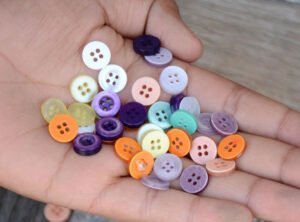
Custom button development is not limited to changing the outer shape. The surface can also be used to create a particular visual effect. Depending on the product, buyers may look for glossy, matte, chalk-like, pearl, transparent, layered or other appearances. For Button Manufacturers in India, these requirements create opportunities to develop buttons that look substantially different while retaining polyester as the basic material. Classic Buttons’ product range includes several distinct surface and finish categories, including pearl and shiny, matte and dull, chalk and transparent buttons.
8. LAYERED DESIGNS CAN CREATE DEPTH AND CONTRAST
Layering is another area where custom polyester buttons can offer something that a simple one-piece appearance cannot. Different colours, tones or surface elements can be combined to create depth and contrast within the same button. This gives Button Manufacturers in India scope to work with designs that are more visually detailed without necessarily changing the underlying material category. Classic Buttons includes two-layer and three-layer button designs within its product range, illustrating how polyester can be used for more complex visual treatments.
9. CUSTOM BUTTONS CAN BE DEVELOPED FOR SPECIFIC PRODUCT RANGES
Different product ranges can have different design languages, even when they come from the same brand. A formal collection may favour restrained details, while a fashion-led range may call for more visible or decorative elements. This creates a need for Button Manufacturers in India to handle custom requirements at the product-range level rather than assuming that every customer needs one permanent button style. The ability to develop variations within polyester allows buyers to adapt their buttons to individual product concepts while keeping the manufacturing material consistent.
10. CUSTOMISATION CAN HELP PRODUCTS STAND OUT IN CROWDED CATEGORIES
In categories where many products share similar basic forms, differentiation becomes harder to achieve through the main construction alone. Accessories can provide another route. A distinctive button can add a recognisable detail without requiring a complete change to the product. This is one reason Button Manufacturers in India are increasingly involved in product-development discussions rather than only fulfilling standard purchase orders. A carefully designed button can contribute to the overall perception of a product while remaining a relatively small component.
11. DIGITAL-LED FASHION IS MAKING VISUAL DETAILS MORE IMPORTANT
The growth of digital fashion retail has changed how customers discover products. Online shoppers often encounter products through photographs and short-form visual content before they ever handle them physically. Deloitte’s recent India fashion analysis identifies wider digital access and evolving consumer expectations as important forces shaping the country’s fashion market. This makes small visible details more relevant because buttons appear directly in product photography. For Button Manufacturers in India, customised colours, finishes and shapes can therefore contribute to how a product is visually presented online as well as how it appears in person.
12. CUSTOM BUTTONS CAN SUPPORT DIFFERENT BRAND POSITIONING
A button with a simple finish communicates something different from one with a highly decorative surface or distinctive branded detail. This makes button choice relevant to how a product is positioned. Button Manufacturers in India serving different market segments may therefore need to support a broader spectrum of custom designs, from understated products to visually prominent accessories. Polyester is useful here because its design flexibility allows the manufacturer to produce varied appearances without limiting the customer to one particular style.
13. CUSTOM BUTTONS ARE NOT LIMITED TO LARGE OR HIGH-FASHION PRODUCTS
Customisation is sometimes associated only with premium fashion, but the requirement can arise in many types of products. Uniforms, corporate clothing, private labels, workwear and other product categories can also use buttons designed around a particular colour, branding requirement or product specification. This broadens the scope of work for Button Manufacturers in India because customisation is not necessarily tied to one type of buyer. The underlying requirement is simply that the button needs to perform a defined visual or branding role.
14. TECHNOLOGY HAS EXPANDED WHAT CAN BE DONE WITH BUTTON DESIGN
Changes in manufacturing technology have increased the range of operations available for button development. Laser engraving is one example where technology allows additional branding or design information to be applied to an established button product. Classic Buttons has incorporated laser technology for name engraving as part of its product capabilities. For Button Manufacturers in India, such technologies expand customisation beyond basic changes in colour or shape and allow more detailed customer-specific requirements to be incorporated into the finished button.
15. CUSTOM DESIGN REQUIRES CLOSE COORDINATION BETWEEN DESIGN AND MANUFACTURING
A custom button begins with an idea, but that idea ultimately has to be translated into a manufacturable product. Dimensions, shape, surface, colour and other features need to work together rather than being considered independently. For Button Manufacturers in India, this makes product-development communication important because the manufacturer’s role is to translate the intended design into a practical button specification. An experienced manufacturer can help identify which elements are essential to the design and how they can be incorporated into polyester button production.
16. POLYESTER MAKES CUSTOMISATION PRACTICAL ACROSS DIFFERENT APPEARANCES
The continued relevance of polyester in custom button development comes largely from its versatility. It can be used for buttons with different colours, surface effects, shapes, layers and decorative treatments. This provides Button Manufacturers in India with a broad material base for developing varied products without having to move into a completely different material for every design request. For buyers, that means greater freedom to develop a button around the product rather than accepting a limited set of predetermined appearances.
17. CUSTOM BUTTONS ALSO REQUIRE A CLEAR FINAL REFERENCE
The more specific a button requirement becomes, the more important it is to establish exactly what the final product should look like. A physical sample or approved design reference provides a clear point of comparison before production moves ahead. For Button Manufacturers in India, this is especially useful for custom products because descriptions alone may not fully communicate colour, surface effect or shape. Clear references help ensure that the design discussed with the customer is the design ultimately manufactured.
18. THE ROLE OF BUTTON MANUFACTURERS IS MOVING CLOSER TO PRODUCT DEVELOPMENT
The growth of custom button demand reflects a wider change in the relationship between apparel businesses and accessory suppliers. Button Manufacturers in India are increasingly expected to contribute to product development by understanding what the buyer is trying to achieve and translating that requirement into a workable button design. The manufacturer is no longer simply supplying an existing component; in many cases, it is helping turn a product idea into a physical accessory.
For Classic Buttons, this approach fits naturally with a manufacturing business that places emphasis on customisation. Its polyester button portfolio includes multiple designs and finishes, while its manufacturing capabilities allow customer-specific requirements to be incorporated where required. The growing demand for custom button designs is closely connected to the increasing importance of product differentiation, visual presentation and brand identity. As apparel businesses look for more ways to make individual products distinctive, buttons provide a practical design element that can be adapted through colour, shape, surface treatment, layering and branding.
For Button Manufacturers in India, this has changed the nature of customer requirements. Buyers may no longer be looking simply for a standard button in a particular size. They may need a button developed specifically around the visual identity, product concept or branding requirements of a particular range. Polyester is well suited to this environment because it provides a flexible base for developing varied colours, finishes, shapes and visual effects. This versatility allows Polyester Button Manufacturers to support both conventional products and more customised requirements within the same broad material category.
Classic Buttons Pvt. Ltd. is one of the leading Button Manufacturers in India, with polyester button manufacturing at the core of its operations and a strong emphasis on customised products. Its range includes different designs and finishes, along with capabilities such as laser engraving for applicable requirements. For businesses working with Button Manufacturers in India, the value of customisation lies in making the button work for the product instead of making the product work around a standard button. That shift is likely to keep custom design an important part of polyester button manufacturing as apparel brands place greater emphasis on distinctive product details.